



What to Expect from Medium Volatility Slots
Medium Volatility Slots sit between the smoother rhythm of low-volatility games and the sharper swings associated with high-volatility slots. The category is useful when comparing games, but it does not promise regular wins or predictable sessions. Volatility, RTP, hit frequency, bonus design, and bet size all play different roles.
Medium Volatility Slots Explained
Volatility describes how widely a slot’s results can vary. In statistical terms, volatility is commonly associated with the standard deviation or variance of a game’s possible results. A higher-volatility game can concentrate more of its payout potential in uncommon, larger prizes, while lower volatility generally produces a narrower spread of results.
Medium volatility occupies the broad space between those two patterns.
That sounds simple, but “medium” should not be treated as a universal mathematical threshold. One developer’s medium-volatility slot may feel quite different from another. Reel structure, multipliers, free spins, jackpots, symbol values, and the amount of theoretical return tied to bonus features can all change the experience.
A typical session may contain:
- Small or moderate wins during normal spins.
- Several losing spins in succession.
- Occasional stronger payouts.
- Bonus rounds capable of producing much larger swings than the base game.
The important point is that medium volatility describes the distribution of possible results. It does not mean the balance will move smoothly up and down.
Payout Patterns Across a Session
Imagine 100 spins on two different medium-volatility games. The first might deliver many modest wins and one strong free-spin round. The second could remain quiet for longer, then return a larger portion of the session’s value through multipliers.
Both can reasonably belong in the same broad volatility category.
Random outcomes also mean that one short session may look nothing like another. A run of losing spins does not prove that a slot has suddenly become more volatile, just as several wins close together do not mean it has become “hot.”
Volatility, RTP and Hit Frequency
These three terms are often placed beside each other, yet they answer different questions.
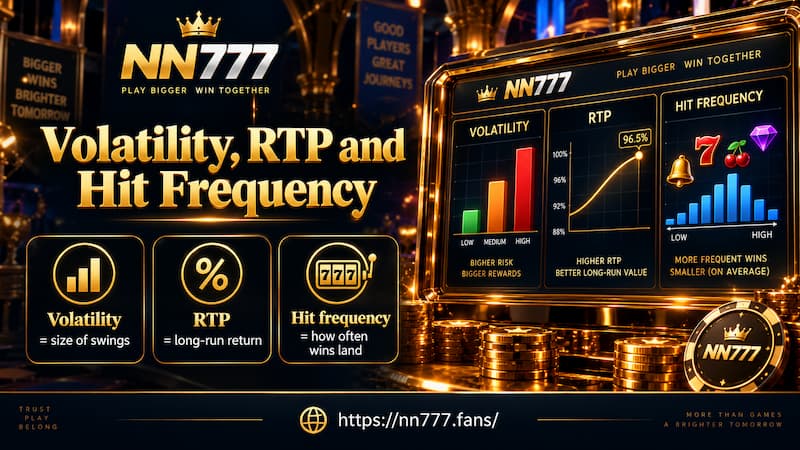
Volatility, RTP and Hit Frequency
RTP Covers Long-Term Theoretical Return
Return to Player, or RTP, represents the theoretical proportion of wagers a game is designed to return over a very large volume of play. It is not a promise for an individual session. Actual results can remain far above or below theoretical RTP over shorter samples because normal volatility creates variation.
A 96% RTP, for example, does not mean depositing or wagering ₱1,000 produces ₱960 back. The figure becomes meaningful over a much larger statistical sample.
Two slots may even have similar RTP figures while producing completely different session patterns.
Hit Frequency Covers How Often Wins Occur
Hit frequency generally concerns how often a winning result appears. It says much less about the size of those wins.
A slot could record frequent low-value wins but still return much of its theoretical payout through less common features. Another might produce fewer winning combinations yet attach more value to each successful result.
That distinction is easy to miss when choosing Medium Volatility Slots.
Same RTP, Different Results
Consider two hypothetical games with the same 96% theoretical RTP:
- Game A distributes more value through frequent payouts between 0.5x and 3x the stake.
- Game B produces fewer ordinary wins but allocates more value to free spins and 20x, 50x, or larger outcomes.
Their long-run RTP can be identical while their short-term balance movement feels completely different.
RTP describes the long-run return built into the mathematics. Volatility describes how unevenly that return may arrive.
How Medium Volatility Slots Behave During Play
Medium volatility does not create a neat compromise where every ten or twenty spins delivers something meaningful. Random sequences remain random.
How Medium Volatility Slots Behave During Play
Losing Runs Remain Part of the Game
Ten losing spins in succession are possible. So are several wins within a short sequence. Neither pattern tells you what the next spin will produce.
This is where the word “medium” can be misleading. It describes an overall mathematical profile rather than setting a ceiling on how rough an individual session can become.
Even official gambling technical guidance accounts for volatility when assessing how far actual RTP can deviate from theoretical RTP over limited samples. Wider variations are expected when fewer games have been played.
Bonus Features Can Carry More of the Swing
Free spins, stacked multipliers, expanding symbols, respins, jackpots, and collection mechanics can change how a medium-volatility game feels. One example is a hold and spin feature, where locked symbols and resettable respins can concentrate more of the action inside a bonus round.
Take Piñata Wins as a concrete example. NN777’s published game information identifies it as medium volatility and lists a 5-reel, 3-row format, Gold Framed multipliers reaching x100, 15 Free Spins from three Scatters, and accumulated multipliers during the bonus feature.
The useful detail is not simply the “medium” label. It is how those mechanics distribute potential payouts between ordinary spins and feature rounds.
Base Game and Bonus Distribution
When comparing two Medium Volatility Slots, check where meaningful payout potential appears.
A game with relatively modest base-game activity but powerful free-spin multipliers may require more patience between stronger moments. Another may spread more value through regular symbol combinations and produce a steadier-looking balance.
The volatility label is the starting point, not the entire profile.
Medium Volatility and PHP Bet Size
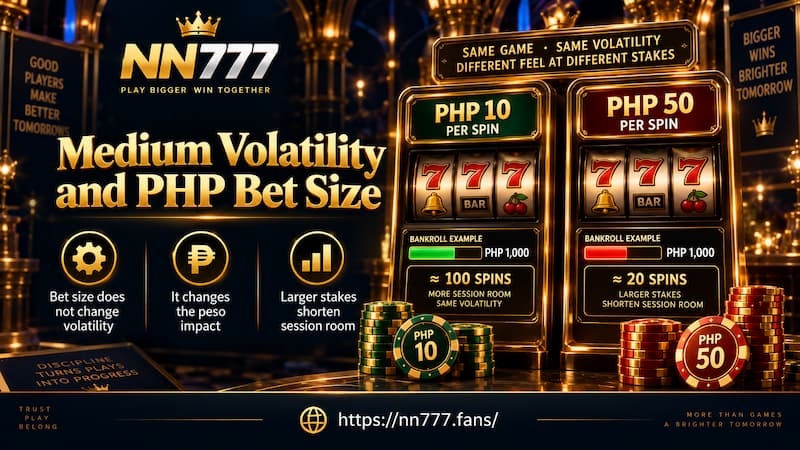
Changing your stake does not change a slot’s underlying volatility. It changes how strongly that volatility affects your money.
That distinction matters when wagering in PHP.
₱10 vs ₱50 per Spin
Suppose you set aside ₱1,000 for a session.
At ₱10 per spin, that amount covers 100 initial wagers before counting any money returned through wins. At ₱50 per spin, it covers only 20.
The mathematical behavior of the game is unchanged, but each movement now has five times the Peso impact.
A 20-spin losing stretch would represent:
- ₱200 wagered at ₱10 per spin.
- ₱1,000 wagered at ₱50 per spin.
The same sequence therefore feels completely different even though the volatility rating has not moved at all.
Bet Size Shapes Session Exposure
A practical way to approach Medium Volatility Slots is to separate two decisions:
- Choose the volatility profile you are comfortable experiencing.
- Choose a PHP stake that allows enough room for the normal swings of that profile.
There is little value in choosing medium volatility for a more moderate experience and then using a stake size so large that a brief losing sequence consumes most of the planned budget.
Low, Medium and High Volatility Compared
The categories become more useful when viewed side by side.
Low Volatility
Low-volatility slots generally concentrate more results around smaller, more frequent payouts. Balance movement can feel smoother, although losses and extended losing sequences remain possible.
Medium Volatility
Medium Volatility Slots allow more variation. Smaller payouts can keep a session moving, while free spins, multipliers, or other features may introduce occasional stronger jumps.
They are not mathematically guaranteed to sit exactly halfway between low and high volatility.
High Volatility
High-volatility games can produce a wider distribution of outcomes, with more payout value potentially concentrated in comparatively rare large prizes. Regulatory guidance describes highly volatile games as capable of containing “very large but rare” prizes, while low-volatility games lean more toward smaller, frequent awards.
The practical difference is exposure: Higher volatility can produce much sharper short-term changes in balance.
Checking Medium Volatility Slots at NN777
When browsing NN777, volatility is more useful when considered alongside the mathematics and mechanics of the individual game rather than treated as a standalone quality score.
Read the Game Information First
Before settling on a slot game, check several details together:
- Volatility rating when the provider publishes one.
- Theoretical RTP.
- Minimum and maximum bet.
- Paytable and symbol values.
- Free-spin conditions.
- Multiplier mechanics.
- Maximum payout.
- Jackpot or bonus features.
One number rarely explains the complete experience.
Piñata Wins is a useful example because the medium-volatility classification sits alongside a published 96.76% RTP, maximum potential of x5,000 the wager, free spins, and multipliers reaching x100. Those details reveal considerably more about its structure than the volatility label by itself.
Large Maximum Wins Need Context
A large advertised maximum win does not automatically make a slot high volatility.
Maximum payout tells you the upper limit of what the game’s rules allow. Volatility concerns the broader distribution of possible outcomes. Bonus frequency, prize probabilities, base-game returns, and feature mathematics all contribute to that distribution.
Build a Complete Game Profile
A useful comparison therefore looks beyond a single label:
Volatility tells you how widely results may swing. RTP describes theoretical return across extensive play. Hit frequency, when available, adds information about win occurrence. Bonus mechanics reveal where larger outcomes may be concentrated. Your PHP bet size then determines how strongly those mathematical swings affect the session budget.
Choosing a Medium-Volatility Game
Medium Volatility Slots make the most sense when selected by profile rather than by label alone.
Check the information screen, read the feature rules, compare the theoretical RTP, and understand how multipliers or free spins work. Then consider the planned stake in Peso terms. A ₱10 spin and a ₱100 spin experience the same underlying game mathematics but create very different financial movement.
Medium volatility can provide a middle range of payout variation, but it cannot predict the next spin, guarantee a certain session length, or turn theoretical RTP into a short-term expectation.
That is the useful way to read the category: Not as a promise of balanced results, but as one piece of information explaining how a slot distributes risk and reward across many possible outcomes.