


How Hold and Spin Features Work in Slots
Hold and spin is a slot feature built around locking special symbols while open positions respin. Here, the focus is simple: how triggers, reset rules, prize values and full-grid outcomes work, plus the details worth checking when choosing a title at NN777.
Hold and Spin as a Slot Mechanic
Hold and spin is usually a bonus or respin feature rather than a separate type of slot. Certain symbols land, those symbols stay fixed, and the open positions keep spinning for a limited number of attempts.
The feature often uses Money, Coin or cash-value symbols. Each may carry a multiplier, fixed amount, jackpot label or another prize value. New qualifying symbols can extend the round by resetting the respin counter.
There is no universal Hold and Spin rule set. Floating Dragon Hold and Spin uses three Money symbols on the middle reel and starts with three respins, while Hot to Burn Hold and Spin requires five or more Money symbols and begins with four.
Hold and Spin, Hold and Win and Related Names
Studios may use names such as Hold & Spin, Hold & Win, Lock and Spin or Money Respins for similar mechanics. The labels can look interchangeable, but the rules are not.
That is why the paytable matters more than the feature name. It gives the actual trigger, reset condition and payout structure for that title.
How Hold and Spin Works
The mechanic is easiest to understand as a short sequence.
How Hold and Spin Works
Triggering the Feature
A Hold and Spin round normally begins when a required number or pattern of special symbols appears. Depending on the game, that could mean:
- Three Money symbols on a particular reel
- Five or more Coin symbols across the grid
- A random bonus activation
- A special symbol completing a set condition
The trigger learned in one slot game should never be assumed to apply to the next.
Symbols Stay Locked
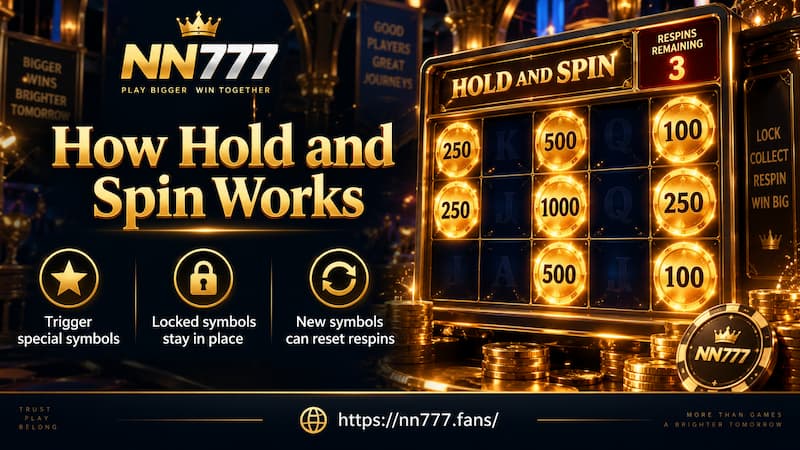
Once the round starts, qualifying symbols usually remain in place while empty positions continue spinning.
This locked-state design is the core of Hold and Spin. Instead of rebuilding the whole screen on every spin, the feature gradually fills space. A round that starts with only a few Money symbols can change quickly if more land.
Respins Reset
Imagine a feature starting with three respins:
- The first respin adds nothing, leaving two.
- The second lands another Money symbol.
- That symbol locks into place.
- The counter resets according to the game’s rules.
- Play continues until the counter reaches zero or another ending condition is met.
Reset rules are not always identical to the starting count. Hot to Burn Hold and Spin starts with four respins, then resets to three when a new sticky Money symbol lands.
When the Round Ends
The feature commonly ends when the respin counter reaches zero or all available positions become occupied.
A full grid does not guarantee the same reward in every title. It may simply collect the visible values, or it may open another feature. Hot to Burn Hold and Spin, for example, moves a full grid into its Big Money Wheel.
How Hold and Spin Prize Values Are Calculated
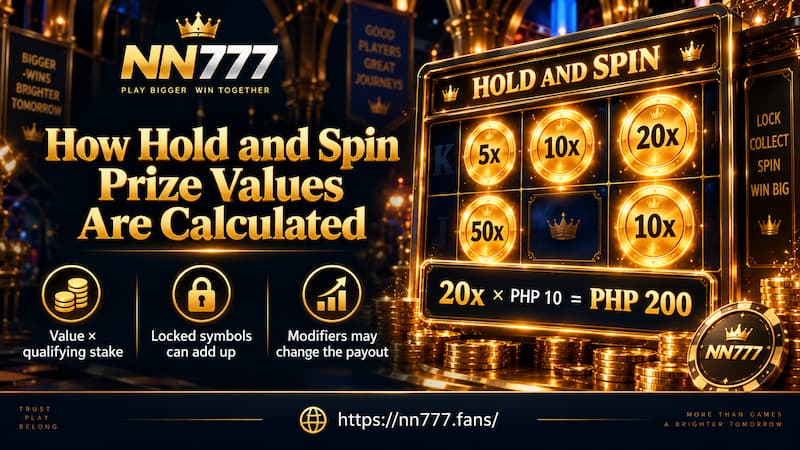
Locked symbols are often displayed as bet multipliers.
How Hold and Spin Prize Values Are Calculated
If a symbol is worth 5x and the qualifying stake is PHP 10, that symbol represents PHP 50 before any extra modifier is applied. A 20x symbol at the same stake represents PHP 200.
The final payout may be the sum of all locked values, but some games add:
- Multipliers
- Collect symbols
- Fixed jackpot symbols
- Expanding grids
- Secondary bonus rounds
The number of locked symbols tells only part of the story. Their values, modifiers and end-of-feature rules determine what the screen is actually worth.
Full-Grid Rewards
Filling every position is often the most dramatic outcome, but it should not be treated as a universal jackpot condition. Some titles award the total grid value; others attach a fixed prize or move into a separate feature. The paytable settles that question.
Hold and Spin vs Free Spins
Both features add play beyond the base game, but they work differently.
Locked Symbols vs Repeated Reel Spins
In a typical Hold and Spin round:
- Qualifying symbols remain fixed.
- Empty positions keep spinning.
- New qualifying symbols may reset the counter.
- Progress usually comes from filling more positions.
In Free Spins:
- Reels generally continue spinning normally.
- Wilds, multipliers or enhanced symbols may be added.
- Extra spins can sometimes be retriggered.
- Locked cash-value symbols are not automatic.
A slot can contain both mechanics. Floating Dragon Hold and Spin includes a Hold and Spin bonus and a separate Free Spins mode, so the two can sit in the same game without serving the same purpose.
Hold and Spin Variations to Check
A good read of the feature rules is more useful than judging the game by its coin animation or theme.
Trigger Requirement
Check how many symbols are needed and where they must land. A three-symbol trigger on one reel behaves differently from five symbols spread across a full grid.
Starting Respins and Reset Rules
Do not assume the feature always starts with three. Check whether every qualifying symbol resets the count and whether it resets to the original number.
Grid Size
More positions create more room for locked symbols, while expanding grids can change the entire shape of the bonus.
Extra Symbols and Modifiers
Collect Symbols
A Collect symbol may gather existing Money values immediately rather than waiting until the feature ends.
Multipliers
Multipliers can affect one prize, a row, a reel or the total, depending on the title.
Jackpot Symbols
Named prizes such as Mini, Minor or Major may appear as fixed-value symbols, but their conditions are game-specific.
Checking Hold and Spin Rules at NN777
When choosing Hold and Spin titles at NN777, the useful details sit in the rules rather than the theme. Before starting a game, check:
- Exact trigger condition
- Minimum and maximum bet
- Money-symbol values
- Starting respins
- Reset rule
- Full-grid result
- RTP, if disclosed
- Volatility, if disclosed
- Maximum-win rule
For a Philippines-facing game using PHP, multiplier math is straightforward. A 10x symbol equals PHP 100 at a PHP 10 qualifying stake and PHP 500 at PHP 50. The multiplier stays the same; the cash amount changes with the wager.
The game information screen should take priority over assumptions carried over from another Hold and Spin title.
Different Hold and Spin Games Can Feel Very Different
The feature name tells you the framework, not the full character of the game.
One title may trigger often with modest Money values. Another may rely on larger multipliers, collectors or a second-stage bonus. The experience can change because of:
- Trigger frequency
- Prize-value distribution
- Grid size
- Respins and resets
- Collect or multiplier symbols
- Jackpot mechanics
- The overall math model
Volatility also belongs to the individual slot, not to Hold and Spin as a category. Even medium-volatility slots with similar coin symbols can have very different pacing and risk profiles.
Hold and Spin in Practice
Hold and spin follows a clear chain: trigger the feature, lock qualifying symbols, respin open positions, reset the counter when the rules allow it, then collect the result under that game’s payout structure.
Once that sequence is clear, the mechanic is easy to follow. The meaningful differences are in the details: trigger conditions, prize values, reset rules and what happens when the grid fills.
- Read more: How Sapaw Works in a Game of Tongits