



How Sic Bo Payouts Change Across Different Bets
Sic Bo Payouts differ sharply depending on the bet placed and the paytable attached to the game. Sic Bo is available through live casino tables and electronic formats. The goal here is simple: Compare the main payouts, understand why they change, and know what to check before putting money on the table.
How Sic Bo Payouts Are Calculated
Three six-sided dice create 216 possible outcomes. That single number explains most of the payout structure.
A bet covering many of those outcomes can hit relatively often, so the return is usually modest. A bet requiring one very specific dice combination is far less likely to land, and the payout rises accordingly.
That is why Sic Bo can place a 1:1 Big bet beside a Specific Triple paying 150:1 or 180:1. The second figure sounds dramatically better, but it represents a completely different probability.
There is another detail worth keeping in mind: Sic Bo does not have one universal payout sheet. Two games can use identical bet names while offering different returns.
Payout Odds and Total Return
A quoted payout normally refers to winnings relative to the stake.
- 1:1 means PHP 100 wins PHP 100.
- 5:1 means PHP 100 wins PHP 500.
- 30:1 means PHP 100 wins PHP 3,000.
- 180:1 means PHP 100 wins PHP 18,000.
The original stake is normally returned separately after a winning wager.
PHP 100 Example
Suppose a PHP 100 bet pays 5:1. A win produces PHP 500 in profit, plus the PHP 100 stake returned to the balance. The total amount credited would therefore be PHP 600.
That distinction matters when comparing game interfaces because some displays emphasize the payout ratio while others make the total return more visually prominent.
Big and Small Keep the Payout Simple
Big and Small are the easiest place to understand Sic Bo Payouts because both commonly pay 1:1.
Small usually covers totals from 4 through 10. Big covers 11 through 17. There is one important condition: A triple normally loses even if the total would otherwise fall inside the selected range.
For example, 3-3-3 totals 9. Nine belongs to the Small range, yet the Small wager still loses because the result is a triple.
Under standard rules, Big and Small each win on 105 of the 216 possible dice combinations. That gives each bet a winning probability of about 48.61% and a house edge of roughly 2.78%.
The Triple Rule Changes the Math
Without the triple exception, Big and Small would behave much more like ordinary even-money bets.
The losing triples are the reason the casino keeps a mathematical advantage while still paying 1:1. It is a small rule on the betting layout, but it has a direct effect on expected return.
Total Bets Create a Steep Payout Curve
Total bets make the relationship between probability and payout much easier to see.
A total of 4 can only appear as:
- 1-1-2
- 1-2-1
- 2-1-1
A total of 10, by comparison, can be created in 27 different ordered combinations. Naturally, the rarer total receives the larger return.
A common Sic Bo paytable may look roughly like this:
- Total 4 or 17: Around 60:1
- Total 5 or 16: Around 30:1
- Total 6 or 15: Around 17:1
- Total 7 or 14: Around 12:1
- Total 8 or 13: Around 8:1
- Total 9 or 12: Around 6:1
- Total 10 or 11: Around 6:1
Those numbers should never be treated as guaranteed across every game. Some providers reduce or increase selected total payouts.
PHP 100 on Two Different Totals
Consider two PHP 100 wagers:
- A total paying 60:1 returns PHP 6,000 in winnings if it lands.
- A total paying 6:1 returns PHP 600 in winnings.
The first return is ten times larger, but the winning total appears far less often.
A high Sic Bo payout is compensation for a narrower winning condition, not proof that the bet offers better mathematical value.
Single Numbers, Doubles and Two-Dice Bets
The middle of the Sic Bo board contains several bets that sit between even-money wagers and extreme long shots.
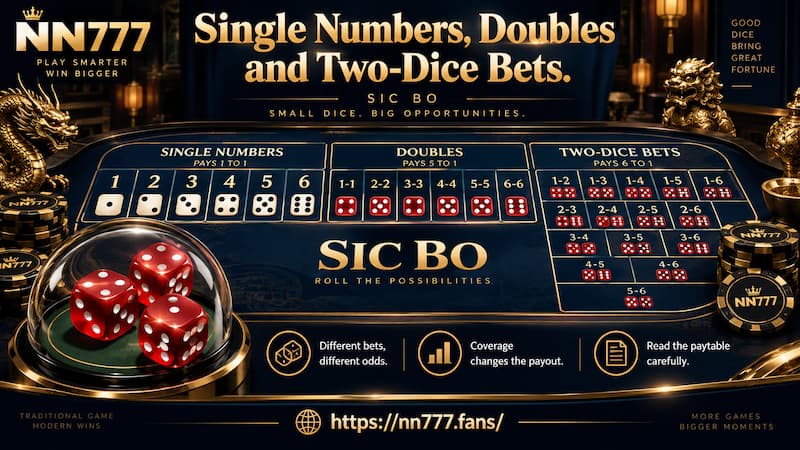
Single Numbers, Doubles and Two-Dice Bets
Single Number Bets
A Single Number wager selects one face, such as 5, and pays according to how many dice show that number.
A common structure is:
- One matching die: 1:1
- Two matching dice: 2:1
- Three matching dice: 3:1 or another provider-specific rate
This bet feels different from most others because one selection can have several payout levels.
If PHP 100 is placed on number 5 and the result is 5-2-5, two dice match. Under a 2:1 rule, the winning amount would be PHP 200 plus the original stake.
Specific Double
A Specific Double requires at least two dice to show a chosen number. Betting Double 4, for instance, needs two or three fours in the final result.
Many Sic Bo tables pay somewhere around 8:1 to 11:1, with 10:1 being a familiar online rate.
Two-Dice Combinations
A combination bet selects two different numbers, such as 2 and 5. Both must appear among the three dice.
Typical returns sit around 5:1 or 6:1.
The condition is much broader than hitting an exact triple but tighter than Big or Small, which explains why the payout sits in the middle.
Triple Bets Sit at the Top of the Paytable
Triples produce some of the largest Sic Bo Payouts because the winning combinations are extremely limited.
Specific Triple
A Specific Triple means choosing an exact result such as 1-1-1 or 6-6-6.
Only one of the 216 possible outcomes produces the chosen triple. The raw probability is therefore about 0.46%.
Depending on the rules, a Specific Triple may pay around 150:1 or 180:1.
A PHP 100 wager at 180:1 would generate PHP 18,000 in winnings if the exact triple appeared. The headline figure is huge, but it comes with a very low hit frequency.
Any Triple
Any Triple removes the need to predict the exact number. The wager wins if the dice show:
1-1-1, 2-2-2, 3-3-3, 4-4-4, 5-5-5, or 6-6-6.
There are six winning outcomes from 216 possibilities, giving a probability of about 2.78%. Common payouts may range from roughly 24:1 to 30:1.
Specific Triple vs Any Triple
Specific Triple offers the larger return because only one exact result wins. Any Triple accepts six possible results, so its payout is lower.
The names sound similar, but mathematically they are very different bets.
Identical Bets Can Carry Different Sic Bo Payouts
A mistake that becomes expensive over time is assuming that a familiar bet must always pay the same rate.
Providers can use the same Sic Bo layout while changing individual payouts. The underlying probability of rolling three dice does not change, but the amount paid for a winning result can.
Variations commonly appear around:
- Specific Triple payouts such as 150:1 versus 180:1
- Any Triple rates around 24:1 to 30:1
- Specific Double payouts around 8:1, 10:1 or 11:1
- Extreme total bets such as 4 and 17
- Single Number returns when all three dice match
That means the paytable deserves attention before the first wager, especially when moving between different live dealers or software providers.
Payout Size and House Edge Are Different Measures
The largest number on the board is not automatically the strongest bet.

Payout Size and House Edge Are Different Measures
A common Big or Small wager pays only 1:1 yet carries a house edge of about 2.78%. A Specific Triple can pay 180:1 while still carrying a substantially higher house advantage.
Some common paytables produce figures around:
- Big or Small: 2.78% house edge
- Total 7 or 14 at 12:1: About 9.72%
- Total 9 or 12 at 6:1: About 18.98%
- Specific Triple at 180:1: About 16.20%
These differences are easy to overlook when attention stays fixed on the payout column.
High Return vs Mathematical Value
Three pieces belong together when comparing Sic Bo bets:
- Probability of winning
- Payout offered
- House edge created by those two numbers
A 180:1 prize creates more excitement than a 1:1 return, but that does not make it mathematically superior. The rarity of the winning event has to be included in the comparison. A similar principle applies to a baccarat tie bet: a larger payout does not automatically offset a low hit probability.
Checking Sic Bo Payouts at NN777
When playing Sic Bo at NN777, check the paytable attached to the specific game rather than relying on a payout chart remembered from somewhere else. Different providers can use different rates even when the betting options look familiar.
Before placing a wager, check four details:
- Whether triples lose on Big and Small
- The exact payout for each total
- Specific Triple and Any Triple rates
- How one, two and three matching dice are paid on Single Number bets
That takes only a few seconds and prevents a much bigger mistake: Comparing two bets as though their rules were identical when they are not.
Sic Bo Payouts in Practice
Sic Bo Payouts rise as winning conditions become narrower, but the size of the return only tells part of the story. Big and Small hit far more often than triples, totals change value according to the number of possible combinations, and provider paytables can alter the return without changing the dice probabilities.
The strongest comparison is therefore not simply “Which bet pays the most?” It is the relationship between payout, probability and house edge. Once those three numbers are read together, the Sic Bo board becomes much easier to understand.