



How Betting Became Part of Filipino Gaming Culture
Filipino Betting Traditions did not begin with smartphones, casino apps, or online sportsbooks. They grew through cockpits, racecourses, lottery draws, neighborhood number games, and regulated casinos. Each generation changed how bets were placed, but prediction, competition, chance, and social participation remained closely connected.
Filipino Betting Traditions Before Modern Casinos
Long before casino floors became familiar, wagering already had a place in everyday recreation. Cockfighting became one of the clearest examples. A sabong event was never only about two roosters entering a pit. Around it sat owners, handlers, spectators, experienced bettors, and people who had spent years learning how to read a fight.
Colonial authorities repeatedly tried to control gambling through restrictions, licenses, and taxation. That history matters because Filipino Betting Traditions developed in an unusual space: Betting could be socially familiar while still being closely watched by government.
Cockfighting as a Community Event
Traditional sabong brought betting into a setting where personal knowledge carried weight. Bettors might study a rooster’s size, condition, previous performance, fighting style, or breeder reputation before committing money.
Someone attending regularly could build opinions that went far beyond picking a side at random.
The atmosphere also made wagering highly social. A bettor could hear arguments from several directions before a fight even started. Confidence moved quickly through the crowd, especially when a respected handler or known fighting line was involved.
The Kristo and the Human Betting System
Before digital betting slips and automated odds, the kristo performed an essential job inside many cockpits. Hand signals, shouted wagers, memory, and rapid calculations allowed numerous bets to be handled almost simultaneously.
That system says a lot about older Filipino Betting Traditions. Betting was not separated from the event by a screen. The people arranging wagers stood inside the same noisy environment as everyone else.
The betting experience was built around people, reputation, observation, and the energy of the event itself.
Cockfighting later became formally regulated under Philippine law, creating clearer distinctions between permitted events and unlawful activity.
Lotteries Made Betting More Accessible
Cockfighting required an event. Lottery betting required a number.
Organized lotteries appeared in the Philippines during the Spanish colonial period, with historical records tracing formal lottery activity to the 1830s. Government sweepstakes later developed into a more institutionalized system, eventually becoming associated with the Philippine Charity Sweepstakes Office.
This changed the nature of participation.
A person did not need to understand fighting roosters, race form, or casino rules. Buying a ticket was simple, and the result could be followed without attending a physical competition.
Numbers Enter Everyday Betting Culture
Number betting created a different type of anticipation. Instead of watching an opponent lose, the bettor waited for a combination to appear.
Numbers could also acquire personal meaning. Birthdays, anniversaries, memorable dates, dreams, and familiar sequences often became part of how people chose combinations. These habits did not alter the mathematics of a draw, but they made the experience feel personal.
Filipino Betting Traditions therefore developed through several distinct approaches:
- Knowledge-based judgment in activities such as horse racing or cockfighting
- Number selection built around chance and personal preference
- Direct casino games with clearly defined rules and payouts
- Sports wagers based on teams, athletes, odds, and match conditions
The common element was uncertainty. The way people interacted with that uncertainty kept changing.
Horse Racing Brought More Structure to Wagering
Horse racing added another important layer. Organized racing in Manila dates back to the nineteenth century, and the development of race clubs created a more formal environment for betting.

Horse Racing Brought More Structure to Wagering
Unlike a neighborhood wager, a horse race offered scheduled events, named competitors, race information, and organized betting mechanisms.
Race Form, Odds and Scheduled Events
A race bettor could compare horses rather than simply choose a lucky number. Previous results, jockeys, distance, track conditions, and odds all became part of the decision.
That introduced a pattern still visible in modern sports betting:
- Review the event before placing money.
- Compare competitors and available information.
- Decide whether the offered odds justify the risk.
- Place the wager before the event begins.
- Wait for a clearly defined result.
This structure feels familiar today because digital sportsbooks use many of the same basic principles, even though the transaction now happens in seconds.
From Racecourse Knowledge to Sports Data
The information available to bettors has expanded enormously. A racing fan once depended heavily on track information and experience. A modern sports bettor may compare statistics, team news, recent form, lineups, and live odds from a phone.
The method changed. The instinct to form an opinion before an uncertain result did not.
Informal Number Games Created a Parallel Tradition
No history of Filipino Betting Traditions is complete without recognizing the difference between authorized gambling and underground betting.
Jueteng became one of the best-known informal number games. Its persistence showed that betting culture did not always develop inside official institutions. Local collection networks could operate alongside government lotteries even though the legal status was completely different.
Legal and Illegal Betting Were Never the Same
Jueteng should not be treated as another name for lottery betting. Philippine law specifically identifies and penalizes illegal numbers games, including jueteng.
The distinction is important because similar-looking activities can operate under very different rules.
A legal lottery involves an authorized operator, defined draw procedures, regulated ticket sales, and formal prize settlement. An underground numbers operation does not receive legitimacy simply because its mechanics resemble a lottery.
Regulation Followed Betting Habits
Philippine gambling policy has repeatedly responded to activities that were already popular.
That pattern appeared with cockfighting, lotteries, horse racing, casinos, and eventually digital gambling. Regulation often followed technological and social changes rather than permanently fixing the betting environment with one law.
Casinos Changed the Scale of Filipino Betting
The development of regulated casinos created a setting where several forms of gambling could exist under one roof.
PAGCOR emerged in the 1970s and later received broader authority under Presidential Decree No. 1869. Casino gambling increasingly became connected to formal licensing, government supervision, and centralized operations.
More Games in One Betting Environment
Casino gambling broadened the available choices. Baccarat, blackjack, roulette, slot machines, and related games offered experiences very different from sabong or horse racing.
The physical setting changed as well.
A cockpit revolved around one type of competition. A racecourse worked according to a racing schedule. A casino allowed someone to move between several games during the same visit.
That flexibility would become even more important once gambling moved online.
Filipino Betting Traditions Move Onto Digital Screens
Internet gaming did not create Filipino interest in betting. It changed access.
Sportsbooks, electronic games, online casino titles, and mobile accounts compressed activities that once required separate venues into a single device.
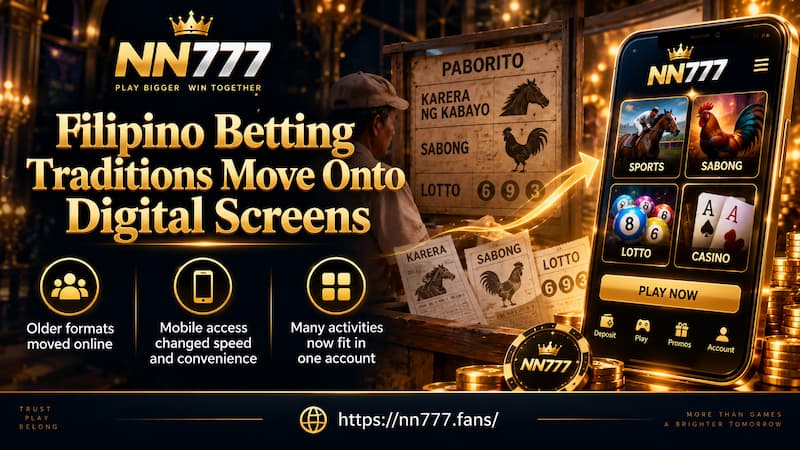
Filipino Betting Traditions Move Onto Digital Screens
A modern bettor can move from a basketball market to a slot game or live casino table without traveling anywhere. Brands such as NN777 represent this newer online-casino environment, where multiple game categories can sit behind one account.
From Physical Venues to Mobile Accounts
The contrast with older betting traditions is striking.
Sabong depended on the cockpit. Horse racing depended on scheduled races. Traditional lottery participation depended on buying a ticket. Casino gambling required a trip to a gaming venue.
Mobile access removes much of that physical friction.
It also changes the pace. Decisions that once required planning can now happen in minutes, which is one reason regulation has increasingly focused on digital safeguards, account controls, and responsible gaming measures.
The Smartphone Replaces the Betting Intermediary
One of the clearest historical changes is the disappearance of many human steps.
The kristo once helped coordinate wagers in a crowded cockpit. A ticket seller handled lottery participation. A racetrack window accepted bets before a race.
Today, software can perform those functions automatically. Stakes are entered on-screen, balances update electronically, and results can be settled without direct interaction with another person.
Betting Culture Today
Filipino Betting Traditions are best understood as a long chain of adaptations rather than a sudden shift toward online gambling.
Cockfighting contributed the social side of wagering. Lotteries made participation simple and widely recognizable. Horse racing introduced structured event betting. Casinos concentrated multiple games in one regulated environment. Digital gaming then removed many of the physical boundaries between them.
Tradition, Regulation and Digital Access
The tools surrounding betting have changed faster than the underlying attraction.
There is still the anticipation before a result, the satisfaction of making a correct prediction, the habit of comparing possibilities, and the emotional pull of an uncertain outcome.
The biggest change is access. A wager once depended heavily on where someone was, which event was taking place, and who was available to accept the bet. Today, many regulated gaming activities can exist inside a mobile account.
From Local Wagers to Online Gaming
That progression explains how betting became part of Filipino gaming culture without reducing the story to casinos alone.
Modern online gaming sits at the newest end of a much older history. The cockpit, lottery ticket, racecourse, casino table, sportsbook, and smartphone may look completely different, but each reflects the same continuing transformation of Filipino Betting Traditions: Familiar forms of risk and prediction adapting to new rules, new technology, and new ways of participating.