



Betting on the First Half vs the Second Half
First Half & Second Half Betting separates a match into two distinct wagering periods, each with its own score, lines and settlement conditions. Available before kickoff or during live play, these markets reward careful reading of timing, tactics and match context rather than relying only on the final result.
How First Half & Second Half Betting Works
First Half & Second Half Betting is built around one simple idea: The result of a wager is decided by what happens during a specific period of the match, not necessarily by the final score.
That distinction matters more than it first appears. A team can lose the first half, dominate after the break and still win a second-half market even if its overall match result tells a different story.
First Half Betting
First-half markets use only the opening period. In football, that normally means the first 45 minutes plus first-half stoppage time.
Common options include:
- First Half Result
- First Half Handicap
- First Half Over/Under
- Team First Half Total
- First Team to Score in the First Half
Suppose Team A leads 1-0 at halftime but eventually loses 1-2. A First Half Team A wager is still settled from the 1-0 halftime position. The comeback after the break has no effect on that first-half result.
Second Half Betting
Second-half betting effectively creates a fresh scoring period after halftime. The actual match score remains important because it changes tactics, but the second-half market usually counts only events occurring after the break.
Consider this football score:
- Halftime: Team A 0-1 Team B
- Full time: Team A 2-1 Team B
- Second-half score: Team A 2-0 Team B
Team A therefore wins the second-half result market 2-0, even though the match itself finishes 2-1.
This is one of the most important concepts to understand before using First Half & Second Half Betting. The scoreboard tells you the match situation; the selected market tells you what actually counts for settlement.
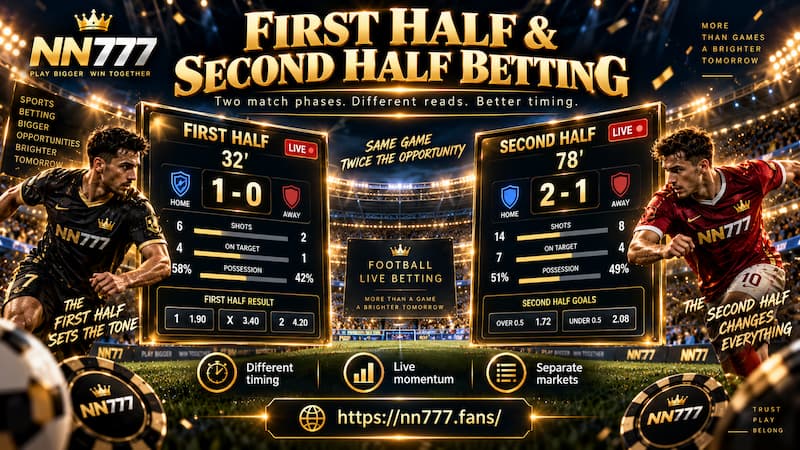
First-Half Betting Starts Before Kickoff
The first half gives you less live evidence to work with, so preparation carries more weight. A team that averages strong first-half results is interesting, but the number becomes far more useful when it matches the expected lineup and tactical setup for that particular match.
First-Half Betting Starts Before Kickoff
Lineups and Early Match Intent
Confirmed starters can completely change the value of a first-half line. A side missing its main striker may still be favored to win the match but could take longer to build pressure. A defensive midfielder returning from suspension may also reduce the chance of an open first 45 minutes.
Before placing a first-half wager, check:
- Starting attackers and defenders
- Formation changes
- Recent rotation
- Injuries or suspensions
- Whether the team normally presses early
- How the opponent handles early pressure
A 4-3-3 on paper does not automatically mean aggressive football. Personnel and instructions matter just as much as formation labels.
Early Scoring Patterns
First-half statistics become useful when they answer a specific question.
Instead of simply seeing that a club “scores often,” look at how often it scores before halftime, how many shots it produces early and whether it regularly enters the break ahead.
The same applies defensively. A team conceding many total goals may still be difficult to break down early before fatigue and tactical changes appear later.
Historical data is context, not a promise. Ten previous matches cannot guarantee what happens in match eleven, but they can reveal whether the line offered fits the team’s normal first-half behavior.
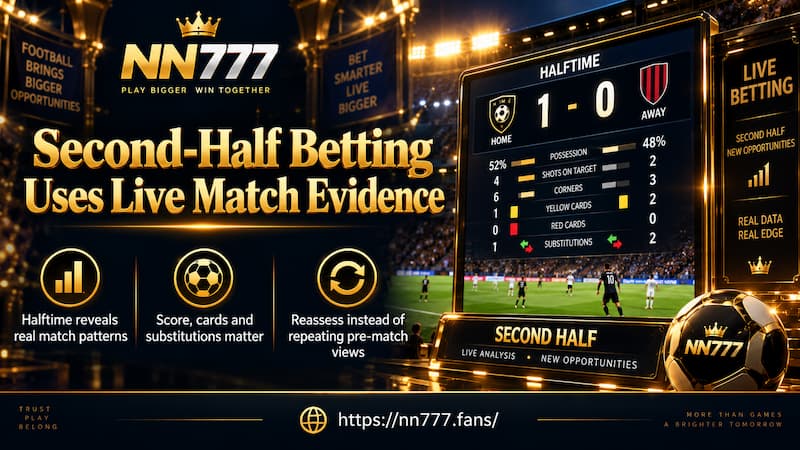
Second-Half Betting Uses Live Match Evidence
Second-half betting starts with something first-half betting cannot provide: Forty-five minutes of actual football.
Second-Half Betting Uses Live Match Evidence
By halftime, expected tactics have become visible. You know who is controlling possession, which defender is struggling, whether the referee is showing cards quickly and whether the pre-match favorite is creating real chances or simply holding the ball harmlessly.
The Halftime Score Changes Incentives
A 0-0 halftime score means something very different when one team desperately needs three points.
Likewise, a 2-0 leader may have little reason to keep playing at the same attacking pace. The trailing side can push more players forward, leaving larger spaces behind.
This is why second-half analysis should not merely repeat the pre-match view.
Ask instead:
- Which team now needs to change the game?
- Has the favorite actually created good chances?
- Is the leader protecting the score or continuing to attack?
- Are substitutions likely to increase the tempo?
- Has a card or injury changed a key matchup?
The answers help separate genuine opportunity from simple reaction to the score.
Cards, Substitutions and Tempo
A red card can transform a second-half market immediately. So can the introduction of a fast winger against a tired full-back or a striker replacing a defensive midfielder.
Even less dramatic changes matter. If one team spent the first half chasing possession, its defensive shape may become harder to maintain after the break.
Second-half betting is not simply betting later. It is betting with a different information set.
That additional information can be valuable, but it does not automatically make the wager better. Live odds move as the match changes, meaning the price may already reflect what everyone can see.
First Half & Second Half Betting Compared
The two markets reward different types of analysis.
Information Available
First-half betting depends heavily on pre-match evidence: Lineups, historical tendencies, matchup quality and expected tactics.
Second-half betting combines those factors with live evidence from the opening period.
That makes the second half more information-rich, but also more dynamic. Prices can change after a goal, card, injury or dangerous spell of pressure.
Scoring Conditions
Some football leagues and competitions historically produce more goals after halftime than before it. Fatigue, tactical adjustments and teams chasing results can all contribute.
That does not mean Second Half Over is automatically the stronger wager.
Sportsbooks are aware of common scoring patterns and can price them into the market. If a second-half total already assumes a more open game, the question is not simply whether goals are likely. The better question is whether the offered line accurately reflects the match developing in front of you.
That distinction separates analysis from chasing trends.
Reading Half Markets on NN777
When First Half & Second Half Betting is available on NN777, read the market title carefully before entering a PHP amount. Several options can look similar while producing very different settlements.
Check the Period and Line
Before confirming anything, identify whether the selection applies to:
- 1st Half
- 2nd Half
- Full Time
- Half Time/Full Time
- First Half Handicap
- Second Half Handicap
- First Half Total
- Second Half Total
For example, PHP 500 on First Half Over 1.5 requires at least two qualifying goals during the first half. A second goal scored shortly after halftime does not rescue the wager.
Half-Time/Full-Time Is Different
Half-Time/Full-Time combines two match states in one selection.
A Team A/Team B choice, for example, generally means Team A must lead at halftime while Team B must be ahead at the end of regulation time.
That is very different from betting separately on Team A to win the first half or Team B to win the second half.
NN777 users should therefore treat the market name as part of the wager itself. A correct opinion entered into the wrong market can still produce the wrong result.
Settlement Rules Deserve Attention
A strong match read is useless if the settlement rules are misunderstood.
Stoppage Time
In football, first-half stoppage time normally belongs to the first half. A goal scored at 45+3 can therefore settle a first-half goal market.
Likewise, second-half stoppage time is normally included in the second-half period.
Extra Time and Overtime
Standard football half markets generally refer to regulation periods and do not automatically include extra time unless the market specifically says otherwise.
Other sports can use different rules. Basketball sportsbooks, for example, may treat overtime differently depending on the market and operator.
Always check the wording rather than carrying assumptions from one sport into another.
Abandoned Matches
A match ending early can produce different settlement outcomes depending on whether the selected period was already completed.
A first-half wager may already have a valid result if the entire first half finished before the match was abandoned. An unfinished second-half market may be treated differently.
The exact result depends on the published house rules for that market.
Choosing Between the First Half and Second Half
There is no universal answer to which half is “better.” The stronger choice is the one supported by the clearest evidence for that specific period.
Before Kickoff
A first-half market is easier to evaluate when you have a strong read on:
- Confirmed lineups
- Early attacking tendencies
- First-half scoring history
- Defensive behavior
- Opponent matchup
- Current odds and line
If most of your reasoning concerns what happens late in matches, it probably does not belong in a first-half bet.
At Halftime
For the second half, reassess rather than defend the prediction you made before kickoff.
Look at the current score, shot quality, cards, substitutions, fitness, tempo and tactical changes. A favorite that looked attractive before kickoff may have shown very little after 45 minutes. Another team may have created several clear chances despite trailing.
Most importantly, responsible gaming means not treating a lost first-half wager as a reason to increase the next stake. The second half is a new market, not an automatic chance to recover PHP lost earlier.
Betting on the Right Half
First Half & Second Half Betting becomes much clearer once each period is treated as its own analytical problem. The first half leans more heavily on pre-match preparation, while the second half adds real match evidence such as score pressure, substitutions, cards and changes in tempo.
Before confirming a selection on NN777, check four things: The period, the market type, the line and the settlement conditions. That small habit prevents many avoidable mistakes and keeps the decision focused on what is actually being wagered on rather than what the final scoreboard happens to show.